
2026-08-28 · 10 min read
Multi-Store Ecommerce Development: Architecture for Multiple Stores
How custom multi-store ecommerce development works: one backend, multiple storefronts, shared catalogue, providers, orders, and a central dashboard.
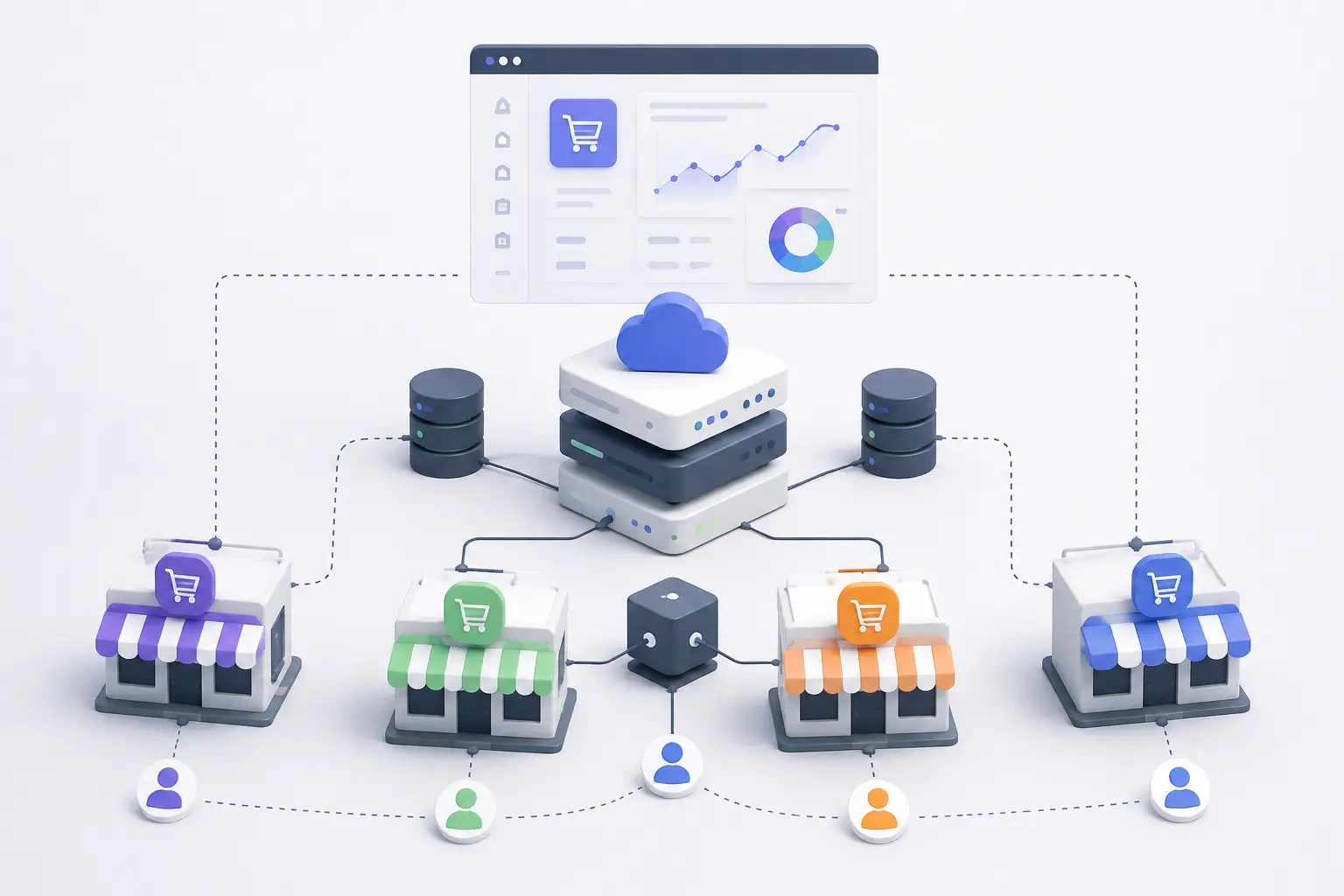
If you already sell through more than one shop — different brands, niches, or countries — the operational question is not how to theme the next store. It is whether each new storefront should become another catalogue, another admin, another provider integration, and another order process.
This article is for operators, CTOs, and ecommerce managers deciding how to develop a multi-store ecommerce system: one commerce backend, several customer-facing stores, and a dashboard the team can run. It is not a guide to installing a multi-store plugin on a hosted platform.
Custom ecommerce development is how the software is built. Multi-store architecture is one of the systems that build can produce. The two ideas belong together; they should not compete for the same page.
What multi-store ecommerce development means
Multi-store ecommerce development is the design and engineering of commerce software where more than one storefront sells from a shared operational core. Each storefront can have its own domain, branding, navigation, product selection, and pricing rules. Shoppers do not need to know another store exists. Products, providers, inventory, orders, payments, and fulfilment can live in the same system.
That is different from launching a second hosted shop and hoping apps stay in sync, cloning a codebase into two nearly identical platforms, or ticking a multi-store feature that still leaves each shop with its own operational gravity. A custom multi-store ecommerce system is infrastructure. The storefront is what the customer sees. The backend is the company.
Headless architecture can be part of that design when presentation is the constraint. If pricing math, stock reservation, or provider availability already break inside a hosted engine, a prettier frontend will not fix it. Multi-store ecommerce development starts with the engine, not the theme.
Why businesses run more than one storefront
Companies add stores for commercial reasons: separate niches, brands, audiences, markets, or tests. Fitness and home convert better as separate shops than as one overloaded navigation. Two brand names need two voices with shared purchasing and fulfilment. Trade and retail should not share a homepage. Country-specific tax, shipping, and catalogue rules belong to that market.
The failure mode is treating each of those as a new ecommerce operation. Without a shared core, every store tends to recreate catalogue management, provider connections, inventory, orders, and reporting. Multi-store ecommerce development exists to stop that duplication — not to force every brand onto one public website.
Single-store vs multi-store architecture
A single-store custom build is still a platform: storefront, catalogue, cart, checkout, accounts, orders, admin. For many businesses that is the right first version. Custom ecommerce development is scoped that way at the lower bands: one storefront plus core commerce.
A multi-store architecture adds an explicit split. Storefronts are independent experiences. The commerce core is shared: products, suppliers, availability, orders, customers, payments, shipping, currencies, and business rules live once. The dashboard is shared: operators assign products to stores, route orders, and handle exceptions without logging into a separate admin per brand.
The design choice is ownership. Which system is the source of truth for SKU, stock, price, and customer? In a cloned-store model, the answer depends on which admin you opened. In a custom multi-store ecommerce system, the answer is the core. Store-specific rules — this SKU on Store A only, wholesale rates on the B2B storefront, warehouse 2 not promising to market C — are software, not a second inventory spreadsheet.
Catalogue, providers, orders, pricing, and inventory
One product record can feed several stores. Assignment — which stores sell which items, under which name or collection — is an operation, not a duplicate SKU list. Providers connect once to the commerce platform through APIs; exact integrations depend on the project. Orders are records in the core, tagged by storefront. Pricing can differ by store or account while referring to the same product. Inventory must be computed centrally or two storefronts can oversell the same unit.
When those five objects are shared, adding a storefront is a commercial decision. When they are not, adding a storefront is another implementation project. API integrations belong in the same engineering model, not as copy-paste after checkout.
Brands, niches, markets, and store-specific rules
Multi-brand ecommerce is a storefront and permissions problem. Multi-niche ecommerce is usually catalogue assignment plus UX. Multiple markets add tax, shipping, currency, and sometimes legal catalogue differences as rules in the core — the same discipline custom ecommerce uses for multi-country and multi-currency work.
None of this requires generic multi-tenant SaaS language. Several stores, one operational system, scoped to how the business actually sells, is enough for operators and buyers to understand the model.
When a custom multi-store system is the right build
A hosted platform with native multi-store features is the right product when the business already fits that platform. Techydra does not implement Shopify or WooCommerce stores. A custom multi-store ecommerce solution makes sense when several storefronts should not clone operations, provider-driven catalogue or fulfilment matters, B2B and B2C share stock with different price lists, or the team needs one dashboard instead of four admins.
You do not have to start with every store. A first version can prove the commerce loop on one storefront, then add more onto software already in use. The complete multi-store platform is not a one-week delivery; the core workflow can be. Cost and sequencing sit on the custom ecommerce development page (from $6,500 for a focused store; multiple storefronts in the higher band).
If the immediate pain is operational — too many admins, duplicated catalogue work — read how to manage multiple ecommerce stores from one platform. If the decision is still hosted store versus platform, custom ecommerce vs Shopify is the comparison.
Frequently asked questions
- Is multi-store ecommerce development the same as custom ecommerce development?
No. Custom ecommerce development is the method: software built around the commercial model, not a hosted theme. Multi-store ecommerce development is a type of system that method can produce — multiple storefronts on one backend.
- Can we start with one store and add more later?
Yes, if the first version is built as a platform with catalogue, orders, admin, and room for store assignment — not as a dead-end theme. Extra storefronts are incremental work on the same core.
- Do you sell a packaged multi-store SaaS?
No. Techydra designs and develops custom ecommerce infrastructure. Scope, integrations, and which stores go live first are project decisions.